
Deutsch: Bankdrücken / Español: Press de banca / Português: Supino / Français: Développé couché / Italiano: Panca piana
The Bench Press is one of the most fundamental and widely recognized strength training exercises in fitness and competitive sports. It primarily targets the upper body, engaging multiple muscle groups while requiring precise technique and controlled execution. As a compound movement, it serves as a cornerstone in both recreational training and professional athletics, often used to measure upper-body strength and progress.
General Description
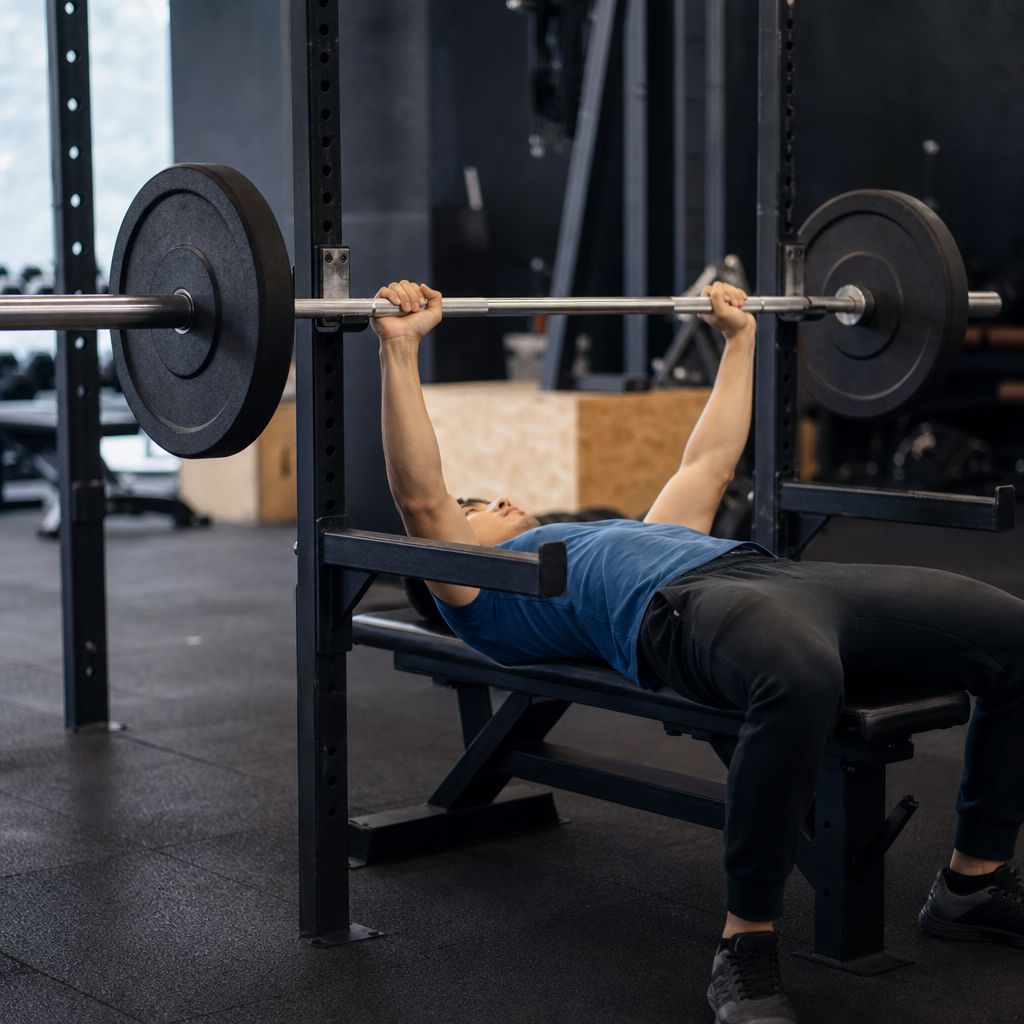
The Bench Press is a weightlifting exercise performed while lying on a horizontal bench, where the individual presses a loaded barbell or dumbbells upward from chest level until the arms are fully extended. The movement involves a controlled descent of the weight to the chest, followed by an explosive upward push. Proper form is critical to maximize effectiveness and minimize the risk of injury, particularly to the shoulders, elbows, and wrists.
The exercise is typically performed on a flat bench, though variations such as the incline or decline Bench Press exist to target different areas of the pectoral muscles. The flat Bench Press remains the standard for general strength development and is a staple in powerlifting competitions, where it is one of the three primary lifts alongside the Squat and Deadlift. The Bench Press is also a key component in bodybuilding routines, where it is used to build muscle mass and definition in the chest, shoulders, and triceps.
Execution of the Bench Press requires coordination between the upper body and core muscles, as stability is essential to maintain proper alignment throughout the movement. The exercise begins with the lifter lying supine on the bench, feet planted firmly on the ground, and the barbell positioned directly above the chest. The grip width can vary depending on the individual's goals, with a wider grip emphasizing the pectoral muscles and a narrower grip placing more emphasis on the triceps. The barbell is lowered to the chest in a controlled manner, typically touching the mid-chest area, before being pressed upward until the arms are fully extended.
Breathing technique plays a significant role in the Bench Press, as proper inhalation and exhalation help stabilize the core and maintain intra-abdominal pressure. Lifters are often advised to inhale deeply before lowering the barbell and exhale forcefully during the upward press. This technique, known as the Valsalva maneuver, enhances stability and reduces the risk of injury by increasing thoracic pressure (source: National Strength and Conditioning Association, 2016).
Technical Details
The Bench Press can be performed using various equipment, including barbells, dumbbells, or specialized machines. The barbell Bench Press is the most common variation, as it allows for progressive overload by incrementally increasing the weight. Dumbbells, on the other hand, offer a greater range of motion and require more stabilization, making them a popular choice for addressing muscle imbalances. Machine-based Bench Press variations, such as the Smith machine, provide guided movement but may limit natural motion and reduce the engagement of stabilizing muscles.
The grip width in the Bench Press significantly influences muscle activation. A wider grip (typically 1.5 to 2 times shoulder width) places greater emphasis on the pectoral muscles, particularly the sternal head of the pectoralis major. A narrower grip (shoulder-width or closer) shifts the focus to the triceps brachii and the clavicular head of the pectoralis major. The choice of grip should align with the lifter's goals, whether they prioritize chest development, triceps strength, or overall upper-body power.
Foot positioning is another critical aspect of the Bench Press. Feet should remain flat on the ground to provide a stable base and prevent excessive arching of the lower back. Some lifters adopt a "leg drive" technique, where they actively push through their heels to generate additional force during the press. This technique can enhance performance but requires careful execution to avoid compromising form.
The Bench Press can be modified to target specific muscle groups or accommodate individual needs. The incline Bench Press, performed on a bench set at a 30- to 45-degree angle, emphasizes the upper pectoral muscles and anterior deltoids. The decline Bench Press, performed on a bench angled downward, shifts the focus to the lower pectoral muscles. These variations are often incorporated into training programs to ensure balanced muscle development and prevent overuse injuries.
Historical Development
The Bench Press has its roots in early 20th-century weightlifting, where it emerged as a supplementary exercise to the overhead press. Initially, the Bench Press was not a competitive lift but rather a tool for building upper-body strength in athletes and military personnel. Its inclusion in powerlifting competitions began in the 1960s, when the sport formalized its rules and standardized the three primary lifts: Squat, Bench Press, and Deadlift. The Bench Press quickly gained popularity due to its accessibility and effectiveness in developing upper-body power.
Over the decades, the Bench Press has evolved in both technique and equipment. Early lifters often performed the exercise without specialized benches or racks, relying on spotters to hand off the barbell. The introduction of the power rack in the mid-20th century revolutionized the Bench Press by allowing lifters to train safely with heavier weights. Advances in barbell design, such as the use of knurling for improved grip, further enhanced performance and safety.
Today, the Bench Press is a global phenomenon, with competitions held at all levels, from local gym challenges to international powerlifting meets. The exercise has also transcended its competitive roots, becoming a staple in general fitness programs, rehabilitation protocols, and even functional training routines. Its versatility and effectiveness have cemented its status as one of the most important exercises in strength training.
Application Area
- Strength Training: The Bench Press is a cornerstone of strength training programs, used to develop upper-body power and muscle mass. It is particularly effective for increasing maximal strength, as it allows for progressive overload through incremental weight increases.
- Powerlifting: As one of the three competitive lifts in powerlifting, the Bench Press is a key metric for assessing an athlete's upper-body strength. Competitors train extensively to maximize their one-repetition maximum (1RM) in this lift.
- Bodybuilding: Bodybuilders use the Bench Press to build and define the pectoral muscles, shoulders, and triceps. Variations such as the incline and decline Bench Press are often incorporated to target specific areas of the chest.
- Rehabilitation: The Bench Press can be adapted for rehabilitation purposes, particularly for individuals recovering from shoulder or chest injuries. Modified versions, such as the floor press or the use of resistance bands, allow for controlled strengthening without excessive strain.
- Functional Fitness: In functional fitness programs, the Bench Press is used to improve overall upper-body strength and stability, which translates to better performance in daily activities and sports.
Well Known Examples
- World Record Bench Press: The current world record for the raw (unequipped) Bench Press in the 120 kg weight class is held by Julius Maddox, who lifted 355 kg (782.6 lbs) in 2020. This achievement highlights the Bench Press as a measure of elite upper-body strength.
- Arnold Schwarzenegger: The legendary bodybuilder and former governor of California famously incorporated the Bench Press into his training regimen to build his iconic chest. His use of the exercise helped popularize it among fitness enthusiasts worldwide.
- CrossFit: The Bench Press is occasionally included in CrossFit workouts, often as part of a strength-focused session. While not a primary movement in CrossFit, it complements other upper-body exercises such as push-ups and overhead presses.
- Military Training: The Bench Press is a standard exercise in military physical training programs, where it is used to assess and develop upper-body strength in soldiers. It is often included in fitness tests alongside push-ups and pull-ups.
Risks and Challenges
- Shoulder Injuries: Improper form, such as flaring the elbows excessively or lowering the barbell too quickly, can place undue stress on the shoulder joints, leading to injuries such as rotator cuff strains or impingement syndrome. Proper technique and gradual progression are essential to mitigate this risk.
- Wrist Strain: A weak or improper grip can cause the wrists to bend backward during the Bench Press, increasing the risk of sprains or chronic pain. Using wrist wraps or focusing on grip strength can help prevent this issue.
- Lower Back Arching: Excessive arching of the lower back, often seen in competitive powerlifters, can reduce the range of motion and increase the risk of lumbar spine injuries. Maintaining a neutral spine and engaging the core muscles are critical for safe execution.
- Pectoral Tears: While rare, pectoral muscle tears can occur during heavy Bench Press attempts, particularly if the lifter loses control of the barbell or uses improper technique. This injury typically requires surgical intervention and a lengthy recovery period.
- Overtraining: Excessive Bench Press training without adequate recovery can lead to muscle imbalances, particularly if the posterior shoulder and upper back muscles are neglected. A balanced training program that includes pulling movements (e.g., rows, pull-ups) is essential to prevent overuse injuries.
Similar Terms
- Incline Bench Press: A variation of the Bench Press performed on an inclined bench, typically set at a 30- to 45-degree angle. This variation emphasizes the upper pectoral muscles and anterior deltoids.
- Decline Bench Press: A variation performed on a declined bench, which shifts the focus to the lower pectoral muscles. This exercise is less common but useful for targeting specific areas of the chest.
- Dumbbell Bench Press: A Bench Press variation using dumbbells instead of a barbell. Dumbbells allow for a greater range of motion and require more stabilization, making them a popular choice for addressing muscle imbalances.
- Floor Press: A Bench Press variation performed while lying on the floor, which limits the range of motion and reduces stress on the shoulders. This exercise is often used in rehabilitation or as a supplementary movement for lifters with shoulder issues.
- Push-Up: A bodyweight exercise that mimics the Bench Press movement but is performed in a prone position. Push-ups are a fundamental exercise for building upper-body strength and endurance, often used as a precursor to the Bench Press.
Summary
The Bench Press is a foundational strength training exercise that targets the chest, shoulders, and triceps while engaging the core for stability. Its versatility makes it suitable for a wide range of applications, from competitive powerlifting to general fitness and rehabilitation. Proper technique, including grip width, foot positioning, and breathing, is essential to maximize effectiveness and minimize injury risk. While the Bench Press offers numerous benefits, including increased upper-body strength and muscle mass, it also presents challenges such as the potential for shoulder injuries or overtraining. By incorporating variations and maintaining a balanced training program, lifters can safely and effectively integrate the Bench Press into their routines. As one of the most iconic exercises in fitness, the Bench Press continues to play a pivotal role in strength development and athletic performance worldwide.
--